The Grammy Effect: Why Album Sales Still Spike 989%
The Grammy Effect: Why Album Sales Still Spike 989%
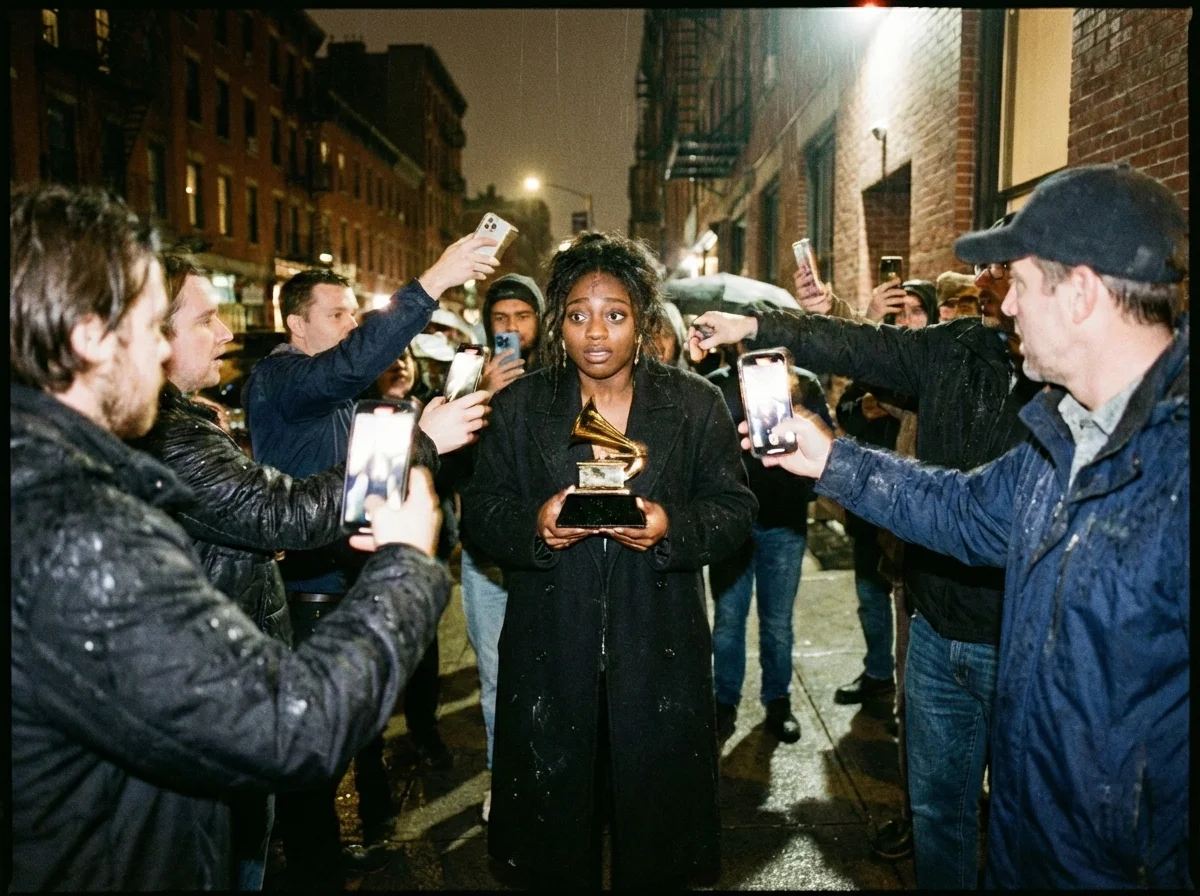
Samara Joy was a jazz vocalist most people had never heard of.
Then she won two Grammys on a Sunday night in February 2023. By Monday morning, her album sales had increased 989%. Her Spotify streams? Up 5,800%. An artist who'd been performing in small clubs was suddenly charting alongside Drake.
That's the Grammy Effect. And last night's 68th Annual Grammy Awards, where Bad Bunny made history as the first Spanish-language Album of the Year winner, Olivia Dean claimed Best New Artist, and Kendrick Lamar became the most-awarded rapper of all time, is poised to trigger one of the biggest Grammy Effects we've ever seen.
The Most Powerful Demand Trigger in Entertainment
Here's what separates the Grammys from every other awards show: you can buy the product while you're watching.
When viewers see an artist perform or accept an award, they can purchase the song for $1.29 within seconds on their phones. Oscar viewers face $15+ tickets, theater travel, and limited showtimes. This friction gap explains why Grammy performers collectively see 328% gains in song sales on the night of the broadcast, while Oscar Best Picture winners average only 57% box office increases.
The Recording Academy has optimized for commerce with surgical precision. Only 12 prizes are given out on air, the lowest of any major awards show. The rest of the runtime? Live performances. NPR describes the Grammys as "shamelessly fine-tuned to spur consumer music purchases." It's essentially a three-hour concert that happens to include some awards.
And what a concert last night was. Tyler, the Creator delivered a three-act theatrical spectacle involving a replica Ferrari F40, a dummy of his earlier persona, and an explosion that left him charred and smoking. Bruno Mars and ROSÉ opened the show with a rock reimagining of "APT." that critics called one of the best Grammy openers in recent memory. Ms. Lauryn Hill made her first Grammy stage appearance in 27 years for a reunion with Wyclef Jean that brought Crypto.com Arena to its feet. Every one of those performances drives commerce.
The 2025 Grammy Awards generated 102 million social interactions, the most social television program ever recorded, exceeding every Super Bowl and presidential debate. Early indicators suggest last night's politically charged ceremony, featuring multiple viral moments, could rival or exceed that record.
When attention concentrates this intensely, demand follows. The question is whether infrastructure can keep up.
The Numbers That Should Make Every Brand Pay Attention
| Artist | Year | Trigger | Sales Increase |
|---|---|---|---|
| Beck | 2015 | Surprise Album of the Year win | 35,000% |
| H.E.R. | 2021 | Song of the Year win | 6,771% |
| Samara Joy | 2023 | Best New Artist + Best Jazz Vocal | 989% |
| Brandy Clark | 2024 | Grammy performance | 150,000% |
| Beyoncé | 2025 | Album of the Year win | 254% |
The pattern is clear: lesser-known artists see percentage increases measured in thousands, while established superstars gain millions in absolute terms. Beyoncé's COWBOY CARTER "only" gained 254% after winning Album of the Year last year, but she was already moving enormous volume. Meanwhile, Samara Joy's 989% came from a near-zero baseline, an unknown artist suddenly thrust into mainstream consciousness.
The duration follows predictable patterns too. Streaming spikes occur immediately during the telecast. Digital downloads peak within 24-48 hours. Physical purchases follow within 3-7 days. Most artists return to pre-Grammy baselines within two weeks.
But here's the kicker: those who are prepared can extend the moment indefinitely. Norah Jones's "Come Away with Me" doubled its sales over three years following her 2003 Grammy sweep.
Category Breakdown: Where the Real Opportunities Hide
Album of the Year generates the biggest headlines, but Best New Artist creates the biggest percentage spikes. Why? Because AOTY typically goes to artists who are already massive. Best New Artist goes to artists on the verge.
Last night's results illustrate this perfectly. Bad Bunny's DeBÍ TiRAR MáS FOToS already logged 152 million first-week streams, the largest for a Latin album in over a year. His Album of the Year win is a seismic cultural moment, but his streaming baseline is enormous. Expect a significant absolute boost, compounded by his Super Bowl LX halftime performance next Sunday, but percentage gains that reflect an already-massive commercial presence.
Compare that to the surprise winners, the artists millions of people are Googling this morning. Lola Young beat Sabrina Carpenter, Chappell Roan, and Lady Gaga for Best Pop Solo Performance. The Cure won their first-ever Grammys after four decades. FKA twigs claimed her first Grammy after 10+ years. Aura V, age 8, became the youngest Grammy winner in history. These are the names that drive discovery streams in the thousands of percent: the Beck at 35,000%, the Samara Joy at 989%.
And then there's Olivia Dean, the Best New Artist winner whose profile mirrors Joy's trajectory almost exactly: a relatively unknown British artist with a neo-soul sound and strong commercial positioning. Best New Artist winners consistently see the largest streaming spikes of any category. Dean's album The Art of Loving was already in the Billboard Top 5 before last night. Expect her numbers, when Luminate releases preliminary data later this week, to be staggering.
The less expected the win, the more dramatic the effect. Sabrina Carpenter going 0-for-6 despite being the night's most visible nominee, repeatedly shown dancing in the audience, tells you everything about how the Grammys manufacture the kind of surprise that feeds the cycle.
Last Night: A Grammy Effect Perfect Storm
Specific streaming spikes from the 68th Grammys won't be reported until February 5-7. Luminate and Billboard typically release preliminary data 3-5 days post-event. But every element that historically drives the largest Grammy Effects was present last night.
A historic, culturally significant Album of the Year win. Bad Bunny's victory is the first for a Spanish-language album in Grammy history. He delivered his acceptance speech entirely in Spanish and opened with a political statement that dominated social media: "Before I say thanks to God, I'm gonna say ICE out. We're not savages, we're not animals, we're not aliens. We are humans, and we are Americans." Historic wins drive extended news cycles, which drive extended commerce windows.
Multiple upset victories driving curiosity streams. Lola Young over Sabrina Carpenter. The Cure winning after 40 years. Nine Inch Nails winning their first Grammy in three decades. Turnstile claiming Best Rock Album. Each upset sends millions of casual viewers to streaming platforms to answer a simple question: who is this?
An exceptionally political, conversation-driving ceremony. Beyond Bad Bunny's speech, Billie Eilish closed her Song of the Year acceptance with a censored "F**k ICE." SZA urged viewers: "Please don't fall into despair. I know right now is a scary time." Olivia Dean dedicated her win as "a granddaughter of an immigrant... a product of bravery." Political Grammy moments extend the news cycle by days, keeping winners' names in headlines far longer than a standard awards show.
A viral gaffe that ensured everyone was talking. Cher, after receiving her Lifetime Achievement Award, forgot she was supposed to present Record of the Year. When Trevor Noah called her back, she opened the envelope and announced "Luther Vandross", confusing Kendrick Lamar and SZA's song title "Luther" with the late soul singer. The moment spawned thousands of memes and drew comparisons to the La La Land/Moonlight Oscar mix-up. SZA responded graciously: "We share the frequency of the song. That's his frequency that allowed us to win." Every meme cycle is a commerce cycle.
Compounding momentum. Bad Bunny's Super Bowl LX halftime performance is next Sunday, a one-two punch of cultural moments that could drive Latin music commerce to unprecedented levels. Kendrick Lamar, now the most-awarded rapper in history with 27 total Grammys, has his own cultural gravity amplifying everything.
Based on historical patterns, here's what we expect the data to show:
- Olivia Dean: 200-500%+ streaming gains, potentially approaching Samara Joy territory given comparable profile and trajectory
- Lola Young: 500%+ spike driven by upset-win curiosity, the classic "who is she?" effect
- Bad Bunny: Significant absolute gains compounded by Super Bowl proximity, though percentage increases moderated by his already-massive 152 million first-week streaming baseline
- Kendrick Lamar: 10-20% catalog gains, consistent with the 9% bump he saw after his 2025 wins, incremental on an enormous base
- The Cure, FKA twigs, Turnstile: First-time winners after long careers historically see some of the most dramatic catalog rediscovery spikes
Real-Time Commerce: The ICE OUT Pin and What It Signals
The most telling commerce story from last night wasn't a streaming spike. It was a pin.
The "ICE OUT" pin campaign, organized by Working Families Power and ACLU-endorsed coalitions, became the ceremony's defining accessory. Black-and-white pins were worn by Justin and Hailey Bieber, Billie Eilish and Finneas, Joni Mitchell, Carole King, Kehlani, Brandi Carlile, and dozens of other artists. Organizers reported demand increasing throughout the broadcast as viewers watched the pins appear on-screen again and again.
This is the Grammy Effect in microcosm: cultural moment triggers demand, demand materializes in real time, and the only question is whether supply can meet it. The ICE OUT pins weren't music. They were a physical product riding the same attention wave that drives streaming spikes, proof that the Grammy Effect extends far beyond album sales to anything adjacent to the cultural moment.
Fashion search trends will follow. Valentino dressed Sabrina Carpenter. Chanel outfitted Olivia Dean. Schiaparelli styled Bad Bunny. Lady Gaga's wicker eyeball headpiece from Matières Fécales drove immediate online conversation. These search-to-sale pipelines typically manifest 48-72 hours post-event.
The Merch Angle: Music's Vinyl Problem Is Drop Culture's Warning
Here's where the Grammy Effect exposes a fundamental infrastructure failure.
Global vinyl pressing capacity sits at approximately 160 million records annually against estimated demand of 300-400 million units. Lead times have expanded from six weeks in 2019 to 9-12 months currently. Artists cannot respond to unexpected Grammy success with physical product for nearly a year.
One Acid Jazz label manager noted that by the time vinyl arrives, "a band might not even be together... or the scene could have moved on completely."
Independent artists suffer disproportionately. Major labels negotiate guaranteed pressing slots months in advance, effectively crowding out smaller acts. Retailers report ordering 90 units and receiving only 14, unable to capitalize on Grammy buzz while inventory sits in pressing queues.
Consider last night's surprise winners. The Cure, Turnstile, and FKA twigs are all about to see massive demand spikes. How many of them have vinyl ready to ship this week? The artists who capture their moment treat Grammy night as one touchpoint in year-round commerce infrastructure, not a surprise requiring reactive scrambling:
- Kendrick Lamar's 2024 Super Bowl halftime merchandise partnership with designer Willy Chavarria had product available through Fanatics and NFL Shop before the performance ended. With his five wins last night and 27 career Grammys, that infrastructure is paying dividends again.
- Billie Eilish built an integrated brand strategy spanning her own merchandise line, fashion collaborations with Nike and Louis Vuitton, and exclusive American Express partnerships, infrastructure that lets her capitalize on moments like her record-breaking third Song of the Year win.
- Taylor Swift generates an estimated $4.6-4.9 billion in consumer spending through her Eras Tour merchandise operation, representing 7% of all U.S. vinyl sold in 2023.
Strategic preparedness separates Grammy winners who capture their moment from those who watch it slip away.
What Sneaker Brands Can Learn from Music
The Grammy Effect demonstrates that predictable cultural moments create predictable demand windows, but the magnitude and specific beneficiaries remain uncertain.
Sound familiar?
This dynamic mirrors sneaker drops, where release dates are known but allocation is random. Or Super Bowl advertising, where the airtime is fixed but response rates vary wildly. According to a 2025 PYMNTS survey, 43% of U.S. shoppers participated in a limited-time drop or flash sale within the previous month.
The playbook for capturing demand during cultural moments follows three phases:
- Pre-event: Infrastructure stress testing for 3-10x normal traffic
- Real-time: Monitoring with activated contingency inventory
- Post-event: 24-72 hour fulfillment that maintains momentum
The "Meghan Effect" has crashed fashion websites three times when the Duchess of Sussex was photographed wearing various brands. Costco lost approximately $11 million during 16.5 hours of Thanksgiving downtime. Gymshark surrendered $143,000 in eight hours from a single application bug.
Unprepared retailers turn viral moments into technical catastrophes rather than commercial victories.
The Infrastructure Imperative
The Grammy Effect is commerce at the speed of culture. Demand materializes in seconds, peaks within hours, and dissipates within weeks.
Last night proved it again. Bad Bunny made history. Olivia Dean's streaming numbers are about to explode. Lola Young, The Cure, FKA twigs, and Turnstile are being discovered by millions of new listeners this morning. The ICE OUT pins couldn't keep up with demand during the broadcast. And with Bad Bunny's Super Bowl halftime show in seven days, the compounding hasn't even started.
For artists and brands, the lesson is the same one it's always been: the greatest barrier to capturing cultural moments isn't generating demand. It's building systems capable of fulfilling it. The vinyl shortage means physical product prepared today won't reach consumers until late 2026. By then, the Grammy moment is a memory.
This is why we built Fanfare around predictable unpredictability. Cultural events create demand spikes that need fair, scalable infrastructure. Whether it's a Grammy win, a sneaker collab, or a Super Bowl halftime performance, the brands that treat these moments as exercises in operational readiness (rather than surprises) consistently outperform those who scramble reactively.
The frenzy from last night is already converting into commerce. The only question is who built the infrastructure to capture it.
The frenzy is a feature. The chaos is optional.
Fanfare helps artists and brands build commerce infrastructure that captures cultural moments. No crashes, no bots, no missed opportunities. Ready to make your next launch matter?
WANT TO TURN YOUR NEXT LAUNCH INTO AN EXPERIENCE?
Join the waitlist to get early access to Fanfare and start building a community of fans, not just customers.